Five days to understand your costs, value your time and plan for uneven income
16–20 November 2026 | Online through ENFIL’s LinkedIn page | Inspired by the Global Entrepreneurship Week
Working for yourself can offer the opportunity to turn a skill into a livelihood, choose the direction of your work and build something of your own. Making that independence sustainable also means understanding the financial decisions behind it. What should you charge? How much of a customer’s payment can you use for personal expenses? Can you afford a quieter month? What happens to your income when you need to stop working?
For freelancers, solopreneurs and people running very small businesses, these questions connect business performance directly with everyday life. A price agreed today can shape next month’s workload. A delayed invoice can affect the money available for household bills. A busy schedule can conceal earnings that are too low to support the person doing the work.
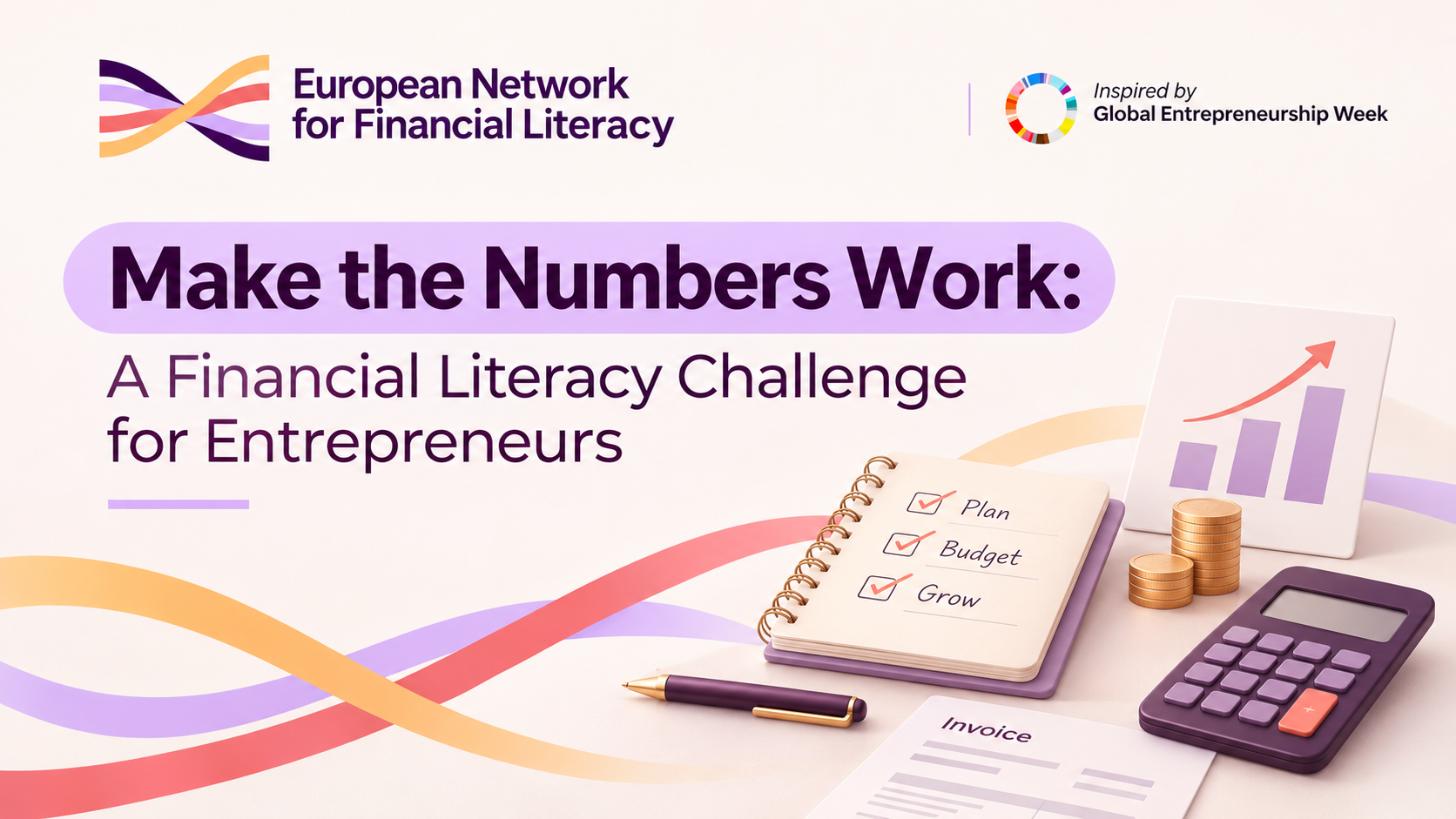
From 16 to 20 November 2026, the European Network for Financial Literacy invites you to take part in Make the Numbers Work: A Financial Literacy Challenge for Entrepreneurs. This five-day LinkedIn challenge focuses on the financial realities of working for yourself and running a very small business. Through practical activities and an accompanying worksheet, participants will explore what their business earns, what it requires and how it supports their personal needs.
The challenge is an independent ENFIL educational initiative inspired by the Global Entrepreneurship Week, which takes place from 16 to 22 November 2026.
Why financial literacy matters for solopreneurs and micropreneurs
People enter entrepreneurship with different ambitions and circumstances. Some want greater autonomy. Others see an opportunity to offer a service, sell a product or earn additional income. Whatever the starting point, expertise in a profession or craft does not automatically provide the financial understanding needed to run a business.
Financial literacy helps people examine different situations, understand the choices available and recognise when they need further information or professional support. Its relevance to small businesses is recognised in the OECD/INFE Core Competencies Framework on Financial Literacy for MSMEs, which sets out financial learning outcomes for people starting, running and growing businesses.
For solopreneurs and micropreneurs whose businesses depend primarily on their own work, several connections deserve particular attention.
Business income and personal security are closely connected
When you work for yourself, your business may be the main source of money for housing, food, family responsibilities and future plans. Decisions about customers, expenses and payment terms therefore have consequences beyond the business.
Yet customer receipts, business profit and money available for personal use are different things. A payment arriving today may need to cover costs already incurred, bills due next month and applicable taxes or social contributions. The balance in an account does not, on its own, show how much can safely be withdrawn.
Financial understanding helps you make these distinctions and plan transfers between business and personal finances more deliberately. Clear records also make it easier to see whether the business is supporting your living costs or whether personal savings are keeping it operating.
Your time is part of the financial picture
In a business built around one person’s work, time places a practical limit on what can be delivered and earned. Every assignment must fit alongside the work required to keep the business running.
Customer communication, preparation, marketing, purchasing, bookkeeping and invoicing all take time. If you calculate a price using only the hours spent delivering the final service, you may overestimate what that work earns.
Consider a fictional assignment priced at €300, with €30 in direct costs. If delivery takes six hours, the remaining €270 appears to represent €45 per hour. Add four hours of preparation and administration, and the figure becomes €27 per hour—before recurring business expenses, taxes, social contributions and other provisions.
Making that time visible creates a better basis for reviewing prices, setting the scope of work and deciding whether an assignment is worthwhile. It also helps you judge whether earning more would require a realistic change or an unsustainable increase in working hours.
Earning money and receiving it happen at different times
A business can generate sales while struggling to meet payments as they fall due. Work may be completed this month, invoiced later and paid several weeks afterwards. Materials, subscriptions and household expenses may need to be paid in the meantime.
Understanding cash flow helps you look ahead to these gaps. It allows you to distinguish expected income from money already available and to explore what would happen if a customer paid late.
That visibility supports practical decisions: discussing deposits or staged payments, invoicing promptly, checking outstanding invoices and reviewing the timing of expenditure. It can also reveal when a commitment would create a cash shortage that needs attention before it becomes urgent.
Your ability to work needs to be part of the plan
For a solo business owner, illness, caring responsibilities or time away can affect both the capacity to deliver work and the income it generates. Longer-term needs, including retirement, also require attention alongside immediate business demands.
The protections available to self-employed people vary across countries and circumstances. Eurofound’s 2024 research documents differences in social protection coverage and highlights the financial insecurity experienced by some groups of self-employed workers, particularly during the pandemic.
Financial literacy can help you identify what you need to check: which contributions you pay, what benefits or protection they provide, what eligibility conditions apply and where gaps may remain. It also encourages realistic planning for periods when you cannot work, using resources that are genuinely available rather than counting the same savings against several different needs.
Understanding your figures can strengthen everyday decisions
A request for a discount, an additional revision or a longer payment period can appear minor in isolation. Repeated across customers, these decisions can materially change the income a business produces.
Knowing your costs, time requirements and payment commitments gives you a clearer basis for assessing such requests. You can identify what a proposed change would mean, explain your terms and consider alternatives.
Financial understanding also makes conversations with accountants, advisers and business-support organisations more useful. You can bring clearer records, ask more precise questions and better understand the implications of the answers.
Financial education must recognise the limits of individual choice
Financial knowledge cannot guarantee sufficient demand, make every customer pay on time or remove gaps in social protection. Some self-employed people have limited influence over their prices and working conditions, particularly when they depend on a small number of clients. Eurofound’s research draws attention to these constraints among economically dependent self-employed workers.
ENFIL’s approach recognises these realities. The purpose of this challenge is to help participants understand their circumstances, identify risks and act where they have room to do so. Accessible advice, fair payment practices and effective social protection remain essential.
A useful outcome may be a better price or a clearer financial routine. It may also be recognising that an arrangement needs to change, that additional support is necessary or that a planned commitment should be reconsidered.
Who is the challenge for?
Make the Numbers Work is designed especially for freelancers, self-employed professionals, solopreneurs and owners of very small businesses, where the owner’s own work generates most of the income. This includes consultants, creatives, tutors, craftspeople, independent service providers and people running a business alongside employment. People preparing to become self-employed are also welcome.
You do not need an accounting qualification or previous financial training. You can use your own figures, clearly labelled estimates or the fictional examples provided. The activities can be adapted to both service-based and product-based businesses.
Five days, five practical challenges
Each day introduces one question and one activity. Together, they help you build a clearer picture of what your business earns, what it requires and how it supports your personal needs.
Day 1: Know what is yours to spend
Monday 16 November
When a customer pays you, how much of that money is actually available to you?
We begin by following a payment through the commitments it needs to cover. These might include delivery costs, recurring business expenses, applicable taxes and social contributions, and upcoming payments.
Your task is to take a recent customer payment – or use a fictional example – and create a simple allocation map. Where an amount is uncertain, mark it for checking rather than guessing.
You will also identify one place where your records could make the distinction between business and personal money clearer.
What you will take away: A better understanding of the difference between money received and money potentially available for personal use.
Day 2: Count the hours behind the price
Tuesday 17 November
Does your price reflect all the work involved?
This activity makes the less visible parts of your working time easier to recognise.
Choose a typical assignment, service or product. Record the revenue, direct costs and total time required, including preparation, communication, administration and delivery. Then explore what changes if the work takes longer than expected or you offer a discount.
The exercise helps you review the assumptions behind your price. Costs and time are important inputs; customer demand and the market also need to be considered.
What you will take away: A fuller picture of what a piece of work earns and one question to resolve before your next quote or pricing decision.
Day 3: Plan for the gaps between payments
Wednesday 18 November
Can the timing of your income support the timing of your bills?
Create a simple eight-week cash calendar showing opening business cash, expected customer receipts, upcoming payments and planned transfers for personal needs.
Distinguish confirmed payments from uncertain prospects. Then move one expected receipt two weeks later and examine the effect on the projected balance.
Identify one response worth investigating, such as clearer payment terms, an agreed deposit, staged payments or a change to the timing of an expense.
What you will take away: A view of potential payment gaps and a practical step to address one of them.
Day 4: Make room for life beyond work
Thursday 19 November
What happens financially when you take time off or cannot work?
Estimate your essential monthly personal spending and identify any reliable income available outside the business. This helps you understand the remaining amount that your business needs to support.
Next, explore what would happen if paid work stopped for two weeks. Which resources would be available? Which commitments would continue? What protection or support would you need to check?
Choose one question about sickness cover, social contributions, pension provision or another relevant area to investigate with an appropriate local source.
What you will take away: A clearer picture of your personal income needs and one gap in information or protection to address.
Day 5: Change one thing that affects your income
Friday 20 November
What have you learned that should change how you work?
On the final day, bring your findings together and choose one concrete next step.
You might review a price, clarify the scope of an assignment, discuss payment terms, examine a recurring expense or establish a regular financial review. You may decide that the next step is to speak to an accountant, business adviser or relevant public authority.
Record what you intend to do, why it matters, what you need to verify and when you will review the result.
What you will take away: A practical action plan grounded in your own circumstances.
How to participate
Follow ENFIL’s LinkedIn page from 16 to 20 November 2026. Each day, we will publish a short scenario, an explanation and an activity linked to the accompanying five-part worksheet.
Allow around 10–15 minutes for a first pass through each exercise. Finding accurate figures or checking local rules may take longer. You can join on any day and revisit the activities at your own pace.
Participation is free, and no registration is required. You are welcome to share a general insight or question in the comments. Keep personal financial information, business records and customer details private.
Use the accompanying worksheet
The Make the Numbers Work worksheet brings the five activities together in one resource:
- A payment allocation map.
- A time-and-price review.
- An eight-week cash calendar.
- A personal continuity snapshot.
- A decision and action plan.
Use it to organise your figures, record uncertainties and identify questions for further support. The exercises are also suitable for discussion with a mentor or adviser.
Download the worksheet and join Make the Numbers Work on LinkedIn.
Understanding your numbers gives you a stronger basis for deciding what to charge, which commitments to accept and how to plan for the future. Through this challenge, ENFIL invites you to take a closer look at the financial decisions shaping your business and the livelihood it provides.
This challenge provides general financial education, not individual financial, accounting, tax or legal advice. Rules and entitlements vary by country and legal form. All fictional examples are for learning purposes.